The CLEVER (Cross Lipschitz Extreme Value for nEtwork Robustness) score is a way of measuring the robustness of an artificial neural network towards adversarial attacks. It was developed by a team at the MIT-IBM Watson AI Lab in IBM Research and first presented at the 2018 International Conference on Learning Representations. It was mentioned and reviewed by Ian Goodfellow as well. It was adopted into an educational game Fool The Bank by Narendra Nath Joshi, Abhishek Bhandwaldar and Casey Dugan
Behavior-based robotics
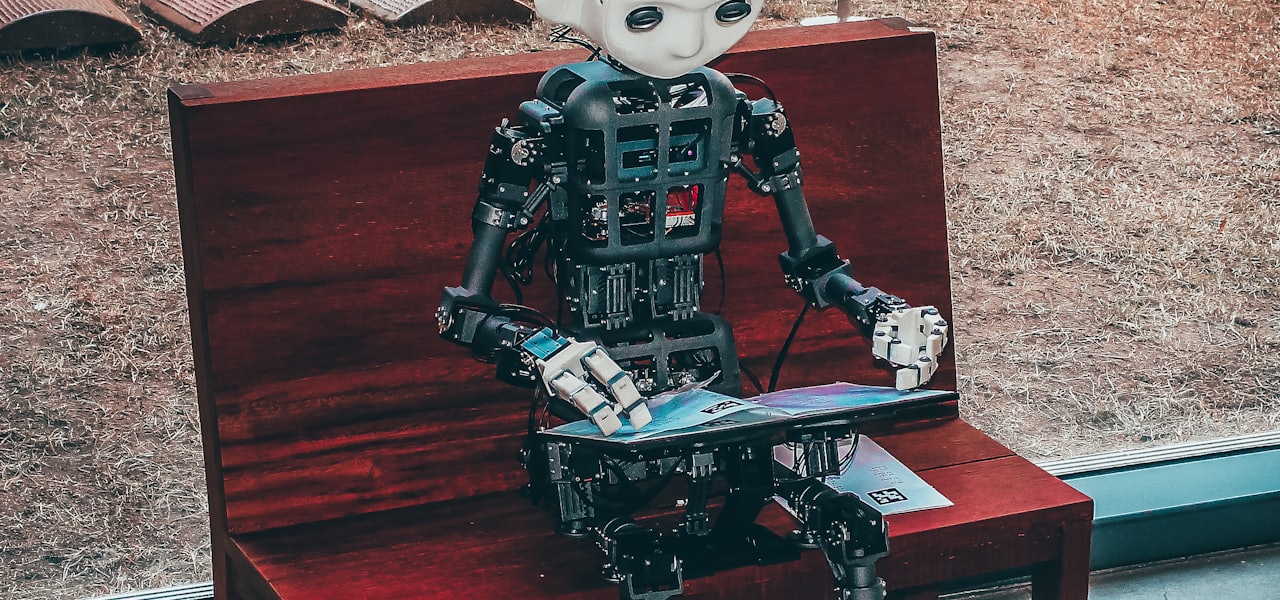
Behavior-based robotics (BBR) or behavioral robotics is an approach in robotics that focuses on robots that are able to exhibit complex-appearing behaviors despite little internal variable state to model its immediate environment, mostly gradually correcting its actions via sensory-motor links. == Principles == Behavior-based robotics sets itself apart from traditional artificial intelligence by using biological systems as a model. Classic artificial intelligence typically uses a set of steps to solve problems, it follows a path based on internal representations of events compared to the behavior-based approach. Rather than use preset calculations to tackle a situation, behavior-based robotics relies on adaptability. This advancement has allowed behavior-based robotics to become commonplace in researching and data gathering. Most behavior-based systems are also reactive, which means they need no programming of what a chair looks like, or what kind of surface the robot is moving on. Instead, all the information is gleaned from the input of the robot's sensors. The robot uses that information to gradually correct its actions according to the changes in immediate environment. Behavior-based robots (BBR) usually show more biological-appearing actions than their computing-intensive counterparts, which are very deliberate in their actions. A BBR often makes mistakes, repeats actions, and appears confused, but can also show the anthropomorphic quality of tenacity. Comparisons between BBRs and insects are frequent because of these actions. BBRs are sometimes considered examples of weak artificial intelligence, although some have claimed they are models of all intelligence. == Features == Most behavior-based robots are programmed with a basic set of features to start them off. They are given a behavioral repertoire to work with dictating what behaviors to use and when, obstacle avoidance and battery charging can provide a foundation to help the robots learn and succeed. Rather than build world models, behavior-based robots simply react to their environment and problems within that environment. They draw upon internal knowledge learned from their past experiences combined with their basic behaviors to resolve problems. == History == The school of behavior-based robots owes much to work undertaken in the 1980s at the Massachusetts Institute of Technology by Rodney Brooks, who with students and colleagues built a series of wheeled and legged robots utilizing the subsumption architecture. Brooks' papers, often written with lighthearted titles such as "Planning is just a way of avoiding figuring out what to do next", the anthropomorphic qualities of his robots, and the relatively low cost of developing such robots, popularized the behavior-based approach. Brooks' work builds—whether by accident or not—on two prior milestones in the behavior-based approach. In the 1950s, W. Grey Walter, an English scientist with a background in neurological research, built a pair of vacuum tube-based robots that were exhibited at the 1951 Festival of Britain, and which have simple but effective behavior-based control systems. The second milestone is Valentino Braitenberg's 1984 book, "Vehicles – Experiments in Synthetic Psychology" (MIT Press). He describes a series of thought experiments demonstrating how simply wired sensor/motor connections can result in some complex-appearing behaviors such as fear and love. Later work in BBR is from the BEAM robotics community, which has built upon the work of Mark Tilden. Tilden was inspired by the reduction in the computational power needed for walking mechanisms from Brooks' experiments (which used one microcontroller for each leg), and further reduced the computational requirements to that of logic chips, transistor-based electronics, and analog circuit design. A different direction of development includes extensions of behavior-based robotics to multi-robot teams. The focus in this work is on developing simple generic mechanisms that result in coordinated group behavior, either implicitly or explicitly.
Communication-avoiding algorithm
Communication-avoiding algorithms minimize movement of data within a memory hierarchy for improving its running-time and energy consumption. These minimize the total of two costs (in terms of time and energy): arithmetic and communication. Communication, in this context refers to moving data, either between levels of memory or between multiple processors over a network. It is much more expensive than arithmetic. == Formal theory == === Two-level memory model === A common computational model in analyzing communication-avoiding algorithms is the two-level memory model: There is one processor and two levels of memory. Level 1 memory is infinitely large. Level 0 memory ("cache") has size M {\displaystyle M} . In the beginning, input resides in level 1. In the end, the output resides in level 1. Processor can only operate on data in cache. The goal is to minimize data transfers between the two levels of memory. === Matrix multiplication === Corollary 6.2: More general results for other numerical linear algebra operations can be found in. The following proof is from. == Motivation == Consider the following running-time model: Measure of computation = Time per FLOP = γ Measure of communication = No. of words of data moved = β ⇒ Total running time = γ·(no. of FLOPs) + β·(no. of words) From the fact that β >> γ as measured in time and energy, communication cost dominates computation cost. Technological trends indicate that the relative cost of communication is increasing on a variety of platforms, from cloud computing to supercomputers to mobile devices. The report also predicts that gap between DRAM access time and FLOPs will increase 100× over coming decade to balance power usage between processors and DRAM. Energy consumption increases by orders of magnitude as we go higher in the memory hierarchy. United States president Barack Obama cited communication-avoiding algorithms in the FY 2012 Department of Energy budget request to Congress: New Algorithm Improves Performance and Accuracy on Extreme-Scale Computing Systems. On modern computer architectures, communication between processors takes longer than the performance of a floating-point arithmetic operation by a given processor. ASCR researchers have developed a new method, derived from commonly used linear algebra methods, to minimize communications between processors and the memory hierarchy, by reformulating the communication patterns specified within the algorithm. This method has been implemented in the TRILINOS framework, a highly-regarded suite of software, which provides functionality for researchers around the world to solve large scale, complex multi-physics problems. == Objectives == Communication-avoiding algorithms are designed with the following objectives: Reorganize algorithms to reduce communication across all memory hierarchies. Attain the lower-bound on communication when possible. The following simple example demonstrates how these are achieved. === Matrix multiplication example === Let A, B and C be square matrices of order n × n. The following naive algorithm implements C = C + A B: for i = 1 to n for j = 1 to n for k = 1 to n C(i,j) = C(i,j) + A(i,k) B(k,j) Arithmetic cost (time-complexity): n2(2n − 1) for sufficiently large n or O(n3). Rewriting this algorithm with communication cost labelled at each step for i = 1 to n {read row i of A into fast memory} - n2 reads for j = 1 to n {read C(i,j) into fast memory} - n2 reads {read column j of B into fast memory} - n3 reads for k = 1 to n C(i,j) = C(i,j) + A(i,k) B(k,j) {write C(i,j) back to slow memory} - n2 writes Fast memory may be defined as the local processor memory (CPU cache) of size M and slow memory may be defined as the DRAM. Communication cost (reads/writes): n3 + 3n2 or O(n3) Since total running time = γ·O(n3) + β·O(n3) and β >> γ the communication cost is dominant. The blocked (tiled) matrix multiplication algorithm reduces this dominant term: ==== Blocked (tiled) matrix multiplication ==== Consider A, B and C to be n/b-by-n/b matrices of b-by-b sub-blocks where b is called the block size; assume three b-by-b blocks fit in fast memory. for i = 1 to n/b for j = 1 to n/b {read block C(i,j) into fast memory} - b2 × (n/b)2 = n2 reads for k = 1 to n/b {read block A(i,k) into fast memory} - b2 × (n/b)3 = n3/b reads {read block B(k,j) into fast memory} - b2 × (n/b)3 = n3/b reads C(i,j) = C(i,j) + A(i,k) B(k,j) - {do a matrix multiply on blocks} {write block C(i,j) back to slow memory} - b2 × (n/b)2 = n2 writes Communication cost: 2n3/b + 2n2 reads/writes << 2n3 arithmetic cost Making b as large possible: 3b2 ≤ M we achieve the following communication lower bound: 31/2n3/M1/2 + 2n2 or Ω (no. of FLOPs / M1/2) == Previous approaches for reducing communication == Most of the approaches investigated in the past to address this problem rely on scheduling or tuning techniques that aim at overlapping communication with computation. However, this approach can lead to an improvement of at most a factor of two. Ghosting is a different technique for reducing communication, in which a processor stores and computes redundantly data from neighboring processors for future computations. Cache-oblivious algorithms represent a different approach introduced in 1999 for fast Fourier transforms, and then extended to graph algorithms, dynamic programming, etc. They were also applied to several operations in linear algebra as dense LU and QR factorizations. The design of architecture specific algorithms is another approach that can be used for reducing the communication in parallel algorithms, and there are many examples in the literature of algorithms that are adapted to a given communication topology.
Informationist
An informationist (or information specialist in context) provides research and knowledge management services in the context of clinical care or biomedical research. Although there is no one educational pathway or formalized set of skills or knowledge for informationists, one way to think of the informationist is as one who possesses the knowledge and skill of a medical librarian with extensive research specialization and some formal clinical or public health education that goes beyond on-the-job osmosis. Medical librarians and other biomedical professional organizations have been exploring the possibilities for evaluating how informationists are being used and whether their activities supplement or replace medical library activity. More generally, an informationist is a professional who works with information within a particular business, analytic or scientific context to drive toward outcomes based on evidence, analysis, prediction and execution. For example, an extension of the term is increasingly emerging in financial services, life sciences and health care industries. Though still nascently in use, its adoption applies to individuals with extensive industry expertise, acute familiarity with organizational structures and processes, deep domain level information mastery and information systems technical savvy. Informationists in this context support transformational initiatives within and across functional areas of an enterprise as architects, governance experts, continuous improvement advocates and strategists. == Background == The term was proposed in 2000 by Davidoff & Florance. Their editorial suggested that physicians should be delegating their information needs to informationists, just as they currently order CT scans from radiologists or cardiac catheterizations from cardiologists. They conceived of an information professional who was embedded in (and indeed, supported by) the clinical departments. Supporters of the concept see it as a means for librarians to reinvigorate connections with the faculty/clinicians, as well as provide superior service by dint of informationists' biomedical training. Critics complained that the idea is nothing new; librarians already provide in-depth, high quality information services and clinical medical librarians have been working alongside physicians, nurses and other clinicians for years. Large informationist programs in the U.S. exist at the National Institutes of Health and at Vanderbilt University. Welch Medical Library at Johns Hopkins University (JHU) is developing an informationist service model in which its 10 clinical and public health librarians are moving from serving as liaison librarians for assigned departments toward becoming embedded informationists within their departments. To prepare for the embedded informationist role, librarians are undertaking education as needed to supplement their backgrounds. For example, librarians bring experience in clinical behavior counseling, public health, nursing, and more. Informationist training can then focus upon filling gaps in research methods knowledge more so than on gaining additional knowledge in the librarian's area of expertise. Courses, seminars and workshops being undertaken include those covering systematic reviews, evidence-based medicine, critical appraisal, medical language, anatomy and physiology, biostatistics, and clinical research. The term informationist is related to that of informatician—also informaticist—and many informationists do possess skills in clinical topics, bioinformatics, and biomedical informatics. Harvard University, the University of Pittsburgh, and Washington University in St. Louis are examples of institutional libraries which have hired PhD-level scientists (who may or may not have library degrees) to provide informatics support for biomedical research.
OpenWSN
OpenWSN aims to build an open standard-based and open source implementation of a complete constrained network protocol stack for wireless sensor networks and Internet of Things. The project was created at the University of California Berkeley and extended at the INRIA and at the Open University of Catalonia (UOC). The root of OpenWSN is a deterministic MAC layer implementing the IEEE 802.15.4e TSCH based on the concept of Time Slotted Channel Hopping (TSCH). Above the MAC layer, the Low Power Lossy Network stack is based on IETF standards including the IETF 6TiSCH management and adaptation layer (a minimal configuration profile, 6top protocol and different scheduling functions). The stack is complemented by an implementation of 6LoWPAN, RPL in non-storing mode, UDP and CoAP, enabling access to devices running the stack from the native IPv6 through open standards. OpenWSN is related to other projects including the following: RIOT OpenMote OpenWSN is available for Linux, Windows and OS X platforms. Current release of OpenWSN is 1.14.0.
Digital transaction management
Digital transaction management (DTM) is a category of cloud services designed to digitally manage document-based transactions. DTM removes the friction inherent in transactions that involve people, documents, and data to create faster, easier, more convenient, and secure processes. DTM goes beyond content and document management to include e-signatures, authentication and non-repudiation; enabling co-browsing between the customer and the business; document transfer and certification; secure archiving that goes beyond records management; and a variety of meta-processes around managing electronic transactions and the documents associated with them. DTM standards are proposed and managed by the xDTM Standard Association Aragon Research has estimated that "by YE 2016, 70% of large enterprises will have a DTM initiative underway or fully implemented."
Web data integration
Web data integration (WDI) is the process of aggregating and managing data from different websites into a single, homogeneous workflow. This process includes data access, transformation, mapping, quality assurance and fusion of data. Data that is sourced and structured from websites is referred to as "web data". WDI is an extension and specialization of data integration that views the web as a collection of heterogeneous databases. Data integration techniques in the context of the web, forms the foundation for businesses taking advantage of data available on the ever-increasing number of publicly-accessible websites. Corporate spending on this area amounted to about USD 2.5bn in 2017, and it is expected that by 2020 the market will reach almost USD 7bn.