Digital content is any content that exists in the form of digital data. Digital content is stored on digital media or analog storage in specific formats. Forms of digital content include information that is digitally broadcast, streamed, or contained in computer files. Viewed narrowly, digital content includes popular media types, while a broader approach considers any type of digital information (e. g. digitally updated weather forecasts, GPS maps, and so on) as digital content. Digital content has increased as more households have accessed the Internet. Expanded access has made it easier for people to receive their news and watch TV online, challenging the popularity of traditional platforms. Increased access to the Internet has also led to the mass publication of digital content through individuals in the form of eBooks, blog posts, and even Facebook posts. == History == At the beginning of the Digital Revolution, computers facilitated the discovery, retrieval, and creation of new information in every field of human knowledge. As information became increasingly more accessible, the Digital Revolution also facilitated the creation of digital content. Despite an evolution to digital technology, which occurred somewhere between the late 1970s, distribution of digital content did not begin until the late 1990s with the rise in popularity of the Internet. In the past, digital content was primarily distributed through computers and the Internet. Methods of distribution are rapidly changing as the Digital Revolution brings new channels, such as mobile apps and eBooks. These new technologies will create challenges for content creators, as they determine the best channel to bring content to their consumers. Despite the benefits, new technologies have created new intellectual property issues. Users can easily share, modify, and redistribute content outside of the creator's control. While new technologies have made digital content available to large audiences, managing copyright and limiting content movement will continue to be an issue that digital content creators face in the future. == Types of digital content == Examples include: Video – Types of video content include home videos, music videos, TV shows, and movies. Many of these can be viewed on websites such as YouTube, Hulu, Paramount+, Disney+, HBO Max, and so on, in which people and companies alike can post content. However, many movies and television shows are not available for free legally, but rather can be purchased from sites such as iTunes and Amazon. Audio – Music is the most common form of audio. Spotify has emerged as a popular way for people to listen to music either over the Internet or from their computer desktop. Digital content in the form of music is also available through Pandora and last.fm, both of which allow listeners to listen to music online for no charge. Images – Photo and image sharing is another example of digital content. Popular sites used for this type of digital content includes Imgur, where people share self-created pictures, Flickr, where people share their photo albums, and DeviantArt, where people share their artwork. Popular apps that are used for images include Instagram and Snapchat. Visual Stories - Stories are a new type of digital content that got introduced by Snapchat. Since then, stories as a format has been introduced in a couple of other platforms such as Facebook and Linkedin. In 2018, Google introduced their AMP Stories, which provides content publishers with a mobile-focused format for delivering news and information as visually rich, tap-through stories. Text - Type of digital content which is available in text or written format. Blog websites which store data in form of textual format. === Paid digital content === In order to have access to more premium digital goods, consumers usually have to pay an upfront charge for digital content, or a subscription based fee. Video – Many licensed videos, such as movies and television shows, require money in order to be viewed or downloaded. Popular services used by many include streaming giant Netflix and Amazon's streaming service, as well as recent notice put forth by the online video platform YouTube. Audio – While songs can be streamed for free, generally in order to download most licensed music, consumers need to purchase songs from web stores, such as the popular iTunes. However, Spotify Premium is emerging as a new model for purchasing digital content on the web: consumers pay a monthly fee to unlimited streaming and downloading from Spotify's music library. According to a report done by IHS Inc. in 2013, the global consumer spending on digital content grew to over $57 billion in 2013, which was up almost 30% from $44 billion in 2012. In past years, the US has always been a leader in consumer expenditure on digital content, but as of 2013, many countries have emerged with great consumer expenditure. South Korea's overall digital spend per capita is now greater than the US. ==== Consolidation ==== According to research firm Ampere Analysis, in 2024, a small group of six media conglomerates; Disney, Comcast, Google, Warner Bros. Discovery, Netflix, and Paramount Global—are poised to dominate the global content market. These companies are projected to account for 51% of all global spending on content, a significant increase from 47% in 2020. Disney, in particular, is a major player, with an estimated $35.8 billion investment in television and film content, representing 14% of global spending. This significant increase, fueled by Disney's full ownership of Hulu, highlights the company's strategic focus on streaming services. A substantial portion of the projected $126 billion global content spending is allocated to streaming platforms. === Non-purchasable digital content === Not all digital content is purchasable, and is simply anything published digitally. This would include: News – in recent years newspapers have attempted to expand their readership by creating access to their newspapers digitally. As of 2012, 39% of readers learned about news from online formats, making news a prevalent form of digital content. Advertisements – as media consumers increasingly use digital formats to watch TV, check the weather, and search for content, advertisements have shifted to digital forms to keep up with their viewership. Advertisements are now being made digitally and placed on sites ranging from Facebook to YouTube. Question and Answer sites – these sites are a type of Internet forum where people can post questions they want answered, or provide responses to previous inquiries. With millions of questions posted each day, anyone has the ability to create content on these sites, so the information provided may not be 100% reliable or accurate. Popular sites include Yahoo! Answers, WikiAnswers and Quora. Web mapping – sites such as MapQuest and Google Maps provide users with map content. These sites give people the ability to quickly look up the location of a landmark and create routes to a destination. Online maps are a form of free content provided by companies such as Google and AOL, serving as much more efficient alternatives to the traditional Thomas Guide. == Business implications == === Digital companies === Digital content businesses can include news, information, and entertainment distributed over the Internet and consumed digitally by both consumers and businesses. Based on revenue, the leading digital businesses are ranked Google, China Mobile, Bloomberg, Reed Elsevier, and Apple. The 50 companies with the highest revenue are split between those offering free and paid digital content, but these top 50 companies combined generate revenue of $150 billion. === Educational opportunities === Programs such as CUNY's Macaulay Honors College in their New Media Lab, run by industry professional Robert Small, is set up to train and introduce students to the various disciplines within the digital content industry. The goal is to offer information and access to professional work opportunities. They also explore within an incubator how to create businesses and start ups within the world of digital content. There are many educational events in support of choosing digital content as a career. === Government support === The Irish government adopted a "Strategy for the Digital Content Industry in Ireland" in 2002.
Caspio
Caspio, Inc. is an American software company providing a low-code platform for building cloud-based business applications. Founded in 2000 by Frank Zamani, the company is headquartered in Sunnyvale, California, with operations in Poland, the Philippines, and Spain. Caspio’s platform allows organizations to create online database applications and workflow tools without extensive coding. == History == Caspio was founded by Frank Zamani in 2000. The company initially focused on simplifying custom cloud applications and reducing development time and cost as compared to traditional software development. Caspio released the first version of its platform, Caspio Bridge, in 2001. In 2014, Caspio released a HIPAA-Compliant Edition of its low-code application development platform. Caspio also released an EU General Data Protection Regulation (GDPR) Compliance Edition of its low-code application development platform in 2016. Caspio's second European Software Development Center opened in Kraków, Poland in 2017. In 2019, Forrester Research listed Caspio and three other platforms in its highest of four ranked tiers of twelve low-code platforms for business developers based on rankings of offerings and strategy at that time. Caspio also opened data centers in Montreal, Canada and India in 2020.
Nonlinear dimensionality reduction
Nonlinear dimensionality reduction (NLDR), also known as manifold learning, is any of various related techniques that aim to project high-dimensional data, potentially existing across non-linear manifolds which cannot be adequately captured by linear decomposition methods, onto lower-dimensional latent manifolds, with the goal of either visualizing the data in the low-dimensional space, or learning the mapping (either from the high-dimensional space to the low-dimensional embedding or vice versa) itself. The techniques described below can be understood as generalizations of linear decomposition methods used for dimensionality reduction, such as singular value decomposition and principal component analysis. == Applications of NLDR == High dimensional data can be hard for machines to work with, requiring significant time and space for analysis. It also presents a challenge for humans, since it's hard to visualize or understand data in more than three dimensions. Reducing the dimensionality of a data set, while keeping its essential features relatively intact, can make algorithms more efficient and allow analysts to visualize trends and patterns. The reduced-dimensional representations of data are often referred to as "intrinsic variables". This description implies that these are the values from which the data was produced. For example, consider a dataset that contains images of a letter 'A', which has been scaled and rotated by varying amounts. Each image has 32×32 pixels. Each image can be represented as a vector of 1024 pixel values. Each row is a sample on a two-dimensional manifold in 1024-dimensional space (a Hamming space). The intrinsic dimensionality is two, because two variables (rotation and scale) were varied in order to produce the data. Information about the shape or look of a letter 'A' is not part of the intrinsic variables because it is the same in every instance. Nonlinear dimensionality reduction will discard the correlated information (the letter 'A') and recover only the varying information (rotation and scale). By comparison, if principal component analysis, which is a linear dimensionality reduction algorithm, is used to reduce this same dataset into two dimensions, the resulting values are not so well organized. This demonstrates that the high-dimensional vectors (each representing a letter 'A') that sample this manifold vary in a non-linear manner. It should be apparent, therefore, that NLDR has several applications in the field of computer-vision. For example, consider a robot that uses a camera to navigate in a closed static environment. The images obtained by that camera can be considered to be samples on a manifold in high-dimensional space, and the intrinsic variables of that manifold will represent the robot's position and orientation. Invariant manifolds are of general interest for model order reduction in dynamical systems. In particular, if there is an attracting invariant manifold in the phase space, nearby trajectories will converge onto it and stay on it indefinitely, rendering it a candidate for dimensionality reduction of the dynamical system. While such manifolds are not guaranteed to exist in general, the theory of spectral submanifolds (SSM) gives conditions for the existence of unique attracting invariant objects in a broad class of dynamical systems. Active research in NLDR seeks to unfold the observation manifolds associated with dynamical systems to develop modeling techniques. Some of the more prominent nonlinear dimensionality reduction techniques are listed below. == Important concepts == === Sammon's mapping === Sammon's mapping is one of the first and most popular NLDR techniques. === Self-organizing map === The self-organizing map (SOM, also called Kohonen map) and its probabilistic variant generative topographic mapping (GTM) use a point representation in the embedded space to form a latent variable model based on a non-linear mapping from the embedded space to the high-dimensional space. These techniques are related to work on density networks, which also are based around the same probabilistic model. === Kernel principal component analysis === Perhaps the most widely used algorithm for dimensional reduction is kernel PCA. PCA begins by computing the covariance matrix of the m × n {\displaystyle m\times n} matrix X {\displaystyle \mathbf {X} } C = 1 m ∑ i = 1 m x i x i T . {\displaystyle C={\frac {1}{m}}\sum _{i=1}^{m}{\mathbf {x} _{i}\mathbf {x} _{i}^{\mathsf {T}}}.} It then projects the data onto the first k eigenvectors of that matrix. By comparison, KPCA begins by computing the covariance matrix of the data after being transformed into a higher-dimensional space, C = 1 m ∑ i = 1 m Φ ( x i ) Φ ( x i ) T . {\displaystyle C={\frac {1}{m}}\sum _{i=1}^{m}{\Phi (\mathbf {x} _{i})\Phi (\mathbf {x} _{i})^{\mathsf {T}}}.} It then projects the transformed data onto the first k eigenvectors of that matrix, just like PCA. It uses the kernel trick to factor away much of the computation, such that the entire process can be performed without actually computing Φ ( x ) {\displaystyle \Phi (\mathbf {x} )} . Of course Φ {\displaystyle \Phi } must be chosen such that it has a known corresponding kernel. Unfortunately, it is not trivial to find a good kernel for a given problem, so KPCA does not yield good results with some problems when using standard kernels. For example, it is known to perform poorly with these kernels on the Swiss roll manifold. However, one can view certain other methods that perform well in such settings (e.g., Laplacian Eigenmaps, LLE) as special cases of kernel PCA by constructing a data-dependent kernel matrix. KPCA has an internal model, so it can be used to map points onto its embedding that were not available at training time. === Principal curves and manifolds === Principal curves and manifolds give the natural geometric framework for nonlinear dimensionality reduction and extend the geometric interpretation of PCA by explicitly constructing an embedded manifold, and by encoding using standard geometric projection onto the manifold. This approach was originally proposed by Trevor Hastie in his 1984 thesis, which he formally introduced in 1989. This idea has been explored further by many authors. How to define the "simplicity" of the manifold is problem-dependent, however, it is commonly measured by the intrinsic dimensionality and/or the smoothness of the manifold. Usually, the principal manifold is defined as a solution to an optimization problem. The objective function includes a quality of data approximation and some penalty terms for the bending of the manifold. The popular initial approximations are generated by linear PCA and Kohonen's SOM. === Laplacian eigenmaps === Laplacian eigenmaps uses spectral techniques to perform dimensionality reduction. This technique relies on the basic assumption that the data lies in a low-dimensional manifold in a high-dimensional space. This algorithm cannot embed out-of-sample points, but techniques based on Reproducing kernel Hilbert space regularization exist for adding this capability. Such techniques can be applied to other nonlinear dimensionality reduction algorithms as well. Traditional techniques like principal component analysis do not consider the intrinsic geometry of the data. Laplacian eigenmaps builds a graph from neighborhood information of the data set. Each data point serves as a node on the graph and connectivity between nodes is governed by the proximity of neighboring points (using e.g. the k-nearest neighbor algorithm). The graph thus generated can be considered as a discrete approximation of the low-dimensional manifold in the high-dimensional space. Minimization of a cost function based on the graph ensures that points close to each other on the manifold are mapped close to each other in the low-dimensional space, preserving local distances. The eigenfunctions of the Laplace–Beltrami operator on the manifold serve as the embedding dimensions, since under mild conditions this operator has a countable spectrum that is a basis for square integrable functions on the manifold (compare to Fourier series on the unit circle manifold). Attempts to place Laplacian eigenmaps on solid theoretical ground have met with some success, as under certain nonrestrictive assumptions, the graph Laplacian matrix has been shown to converge to the Laplace–Beltrami operator as the number of points goes to infinity. === Isomap === Isomap is a combination of the Floyd–Warshall algorithm with classic Multidimensional Scaling (MDS). Classic MDS takes a matrix of pair-wise distances between all points and computes a position for each point. Isomap assumes that the pair-wise distances are only known between neighboring points, and uses the Floyd–Warshall algorithm to compute the pair-wise distances between all other points. This effectively estimates the full matrix of pair-wise geodesic distances between all of the points. Isomap th
Diffusion model
In machine learning, diffusion models, also known as diffusion-based generative models or score-based generative models, are a class of latent variable generative models. A diffusion model consists of two major components: the forward diffusion process, and the reverse sampling process. The goal of diffusion models is to learn a diffusion process for a given dataset, such that the process can generate new elements that are distributed similarly as the original dataset. A diffusion model models data as generated by a diffusion process, whereby a new datum performs a random walk with drift through the space of all possible data. A trained diffusion model can be sampled in many ways, with different efficiency and quality. There are various equivalent formalisms, including Markov chains, denoising diffusion probabilistic models, noise conditioned score networks, and stochastic differential equations. They are typically trained using variational inference. The model responsible for denoising is typically called its "backbone". The backbone may be of any kind, but they are typically U-nets or transformers. As of 2024, diffusion models are mainly used for computer vision tasks, including image denoising, inpainting, super-resolution, image generation, and video generation. These typically involve training a neural network to sequentially denoise images blurred with Gaussian noise. The model is trained to reverse the process of adding noise to an image. After training to convergence, it can be used for image generation by starting with an image composed of random noise, and applying the network iteratively to denoise the image. Diffusion-based image generators have seen widespread commercial interest, such as Stable Diffusion and DALL-E. These models typically combine diffusion models with other models, such as text-encoders and cross-attention modules to allow text-conditioned generation. Other than computer vision, diffusion models have also found applications in natural language processing such as text generation and summarization, sound generation, and reinforcement learning. == Denoising diffusion model == === Non-equilibrium thermodynamics === Diffusion models were introduced in 2015 as a method to train a model that can sample from a highly complex probability distribution. They used techniques from non-equilibrium thermodynamics, especially diffusion. Consider, for example, how one might model the distribution of all naturally occurring photos. Each image is a point in the space of all images, and the distribution of naturally occurring photos is a "cloud" in space, which, by repeatedly adding noise to the images, diffuses out to the rest of the image space, until the cloud becomes all but indistinguishable from a Gaussian distribution N ( 0 , I ) {\displaystyle {\mathcal {N}}(0,I)} . A model that can approximately undo the diffusion can then be used to sample from the original distribution. This is studied in "non-equilibrium" thermodynamics, as the starting distribution is not in equilibrium, unlike the final distribution. The equilibrium distribution is the Gaussian distribution N ( 0 , I ) {\displaystyle {\mathcal {N}}(0,I)} , with pdf ρ ( x ) ∝ e − 1 2 ‖ x ‖ 2 {\displaystyle \rho (x)\propto e^{-{\frac {1}{2}}\|x\|^{2}}} . This is just the Maxwell–Boltzmann distribution of particles in a potential well V ( x ) = 1 2 ‖ x ‖ 2 {\displaystyle V(x)={\frac {1}{2}}\|x\|^{2}} at temperature 1. The initial distribution, being very much out of equilibrium, would diffuse towards the equilibrium distribution, making biased random steps that are a sum of pure randomness (like a Brownian walker) and gradient descent down the potential well. The randomness is necessary: if the particles were to undergo only gradient descent, then they will all fall to the origin, collapsing the distribution. === Denoising Diffusion Probabilistic Model (DDPM) === The 2020 paper proposed the Denoising Diffusion Probabilistic Model (DDPM), which improves upon the previous method by variational inference. ==== Forward diffusion ==== To present the model, some notation is required. β 1 , . . . , β T ∈ ( 0 , 1 ) {\displaystyle \beta _{1},...,\beta _{T}\in (0,1)} are fixed constants. α t := 1 − β t {\displaystyle \alpha _{t}:=1-\beta _{t}} α ¯ t := α 1 ⋯ α t {\displaystyle {\bar {\alpha }}_{t}:=\alpha _{1}\cdots \alpha _{t}} σ t := 1 − α ¯ t {\displaystyle \sigma _{t}:={\sqrt {1-{\bar {\alpha }}_{t}}}} σ ~ t := σ t − 1 σ t β t {\displaystyle {\tilde {\sigma }}_{t}:={\frac {\sigma _{t-1}}{\sigma _{t}}}{\sqrt {\beta _{t}}}} μ ~ t ( x t , x 0 ) := α t ( 1 − α ¯ t − 1 ) x t + α ¯ t − 1 ( 1 − α t ) x 0 σ t 2 {\displaystyle {\tilde {\mu }}_{t}(x_{t},x_{0}):={\frac {{\sqrt {\alpha _{t}}}(1-{\bar {\alpha }}_{t-1})x_{t}+{\sqrt {{\bar {\alpha }}_{t-1}}}(1-\alpha _{t})x_{0}}{\sigma _{t}^{2}}}} N ( μ , Σ ) {\displaystyle {\mathcal {N}}(\mu ,\Sigma )} is the normal distribution with mean μ {\displaystyle \mu } and variance Σ {\displaystyle \Sigma } , and N ( x | μ , Σ ) {\displaystyle {\mathcal {N}}(x|\mu ,\Sigma )} is the probability density at x {\displaystyle x} . A vertical bar denotes conditioning. A forward diffusion process starts at some starting point x 0 ∼ q {\displaystyle x_{0}\sim q} , where q {\displaystyle q} is the probability distribution to be learned, then repeatedly adds noise to it by x t = 1 − β t x t − 1 + β t z t {\displaystyle x_{t}={\sqrt {1-\beta _{t}}}x_{t-1}+{\sqrt {\beta _{t}}}z_{t}} where z 1 , . . . , z T {\displaystyle z_{1},...,z_{T}} are IID (Independent and identically distributed random variables) samples from N ( 0 , I ) {\displaystyle {\mathcal {N}}(0,I)} . The coefficients 1 − β t {\displaystyle {\sqrt {1-\beta _{t}}}} and β t {\displaystyle {\sqrt {\beta _{t}}}} ensure that Var ( X t ) = I {\displaystyle {\mbox{Var}}(X_{t})=I} assuming that Var ( X 0 ) = I {\displaystyle {\mbox{Var}}(X_{0})=I} . The values of β t {\displaystyle \beta _{t}} are chosen such that for any starting distribution of x 0 {\displaystyle x_{0}} , if it has finite second moment, then lim t → ∞ x t | x 0 {\displaystyle \lim _{t\to \infty }x_{t}|x_{0}} converges to N ( 0 , I ) {\displaystyle {\mathcal {N}}(0,I)} . The entire diffusion process then satisfies q ( x 0 : T ) = q ( x 0 ) q ( x 1 | x 0 ) ⋯ q ( x T | x T − 1 ) = q ( x 0 ) N ( x 1 | α 1 x 0 , β 1 I ) ⋯ N ( x T | α T x T − 1 , β T I ) {\displaystyle q(x_{0:T})=q(x_{0})q(x_{1}|x_{0})\cdots q(x_{T}|x_{T-1})=q(x_{0}){\mathcal {N}}(x_{1}|{\sqrt {\alpha _{1}}}x_{0},\beta _{1}I)\cdots {\mathcal {N}}(x_{T}|{\sqrt {\alpha _{T}}}x_{T-1},\beta _{T}I)} or ln q ( x 0 : T ) = ln q ( x 0 ) − ∑ t = 1 T 1 2 β t ‖ x t − 1 − β t x t − 1 ‖ 2 + C {\displaystyle \ln q(x_{0:T})=\ln q(x_{0})-\sum _{t=1}^{T}{\frac {1}{2\beta _{t}}}\|x_{t}-{\sqrt {1-\beta _{t}}}x_{t-1}\|^{2}+C} where C {\displaystyle C} is a normalization constant and often omitted. In particular, we note that x 1 : T | x 0 {\displaystyle x_{1:T}|x_{0}} is a Gaussian process, which affords us considerable freedom in reparameterization. For example, by standard manipulation with Gaussian process, x t | x 0 ∼ N ( α ¯ t x 0 , σ t 2 I ) {\displaystyle x_{t}|x_{0}\sim N\left({\sqrt {{\bar {\alpha }}_{t}}}x_{0},\sigma _{t}^{2}I\right)} x t − 1 | x t , x 0 ∼ N ( μ ~ t ( x t , x 0 ) , σ ~ t 2 I ) {\displaystyle x_{t-1}|x_{t},x_{0}\sim {\mathcal {N}}({\tilde {\mu }}_{t}(x_{t},x_{0}),{\tilde {\sigma }}_{t}^{2}I)} In particular, notice that for large t {\displaystyle t} , the variable x t | x 0 ∼ N ( α ¯ t x 0 , σ t 2 I ) {\displaystyle x_{t}|x_{0}\sim N\left({\sqrt {{\bar {\alpha }}_{t}}}x_{0},\sigma _{t}^{2}I\right)} converges to N ( 0 , I ) {\displaystyle {\mathcal {N}}(0,I)} . That is, after a long enough diffusion process, we end up with some x T {\displaystyle x_{T}} that is very close to N ( 0 , I ) {\displaystyle {\mathcal {N}}(0,I)} , with all traces of the original x 0 ∼ q {\displaystyle x_{0}\sim q} gone. For example, since x t | x 0 ∼ N ( α ¯ t x 0 , σ t 2 I ) {\displaystyle x_{t}|x_{0}\sim N\left({\sqrt {{\bar {\alpha }}_{t}}}x_{0},\sigma _{t}^{2}I\right)} we can sample x t | x 0 {\displaystyle x_{t}|x_{0}} directly "in one step", instead of going through all the intermediate steps x 1 , x 2 , . . . , x t − 1 {\displaystyle x_{1},x_{2},...,x_{t-1}} . ==== Backward diffusion ==== The key idea of DDPM is to use a neural network parametrized by θ {\displaystyle \theta } . The network takes in two arguments x t , t {\displaystyle x_{t},t} , and outputs a vector μ θ ( x t , t ) {\displaystyle \mu _{\theta }(x_{t},t)} and a matrix Σ θ ( x t , t ) {\displaystyle \Sigma _{\theta }(x_{t},t)} , such that each step in the forward diffusion process can be approximately undone by x t − 1 ∼ N ( μ θ ( x t , t ) , Σ θ ( x t , t ) ) {\displaystyle x_{t-1}\sim {\mathcal {N}}(\mu _{\theta }(x_{t},t),\Sigma _{\theta }(x_{t},t))} . This then gives us a backward diffusion process p θ {\displaystyle p_{\theta }} defined by p θ ( x T ) = N ( x T | 0 , I ) {\displaystyle p_{\theta }(x
Generalized iterative scaling
In statistics, generalized iterative scaling (GIS) and improved iterative scaling (IIS) are two early algorithms used to fit log-linear models, notably multinomial logistic regression (MaxEnt) classifiers and extensions of it such as MaxEnt Markov models and conditional random fields. These algorithms have been largely surpassed by gradient-based methods such as L-BFGS and coordinate descent algorithms.
Embodied cognitive science
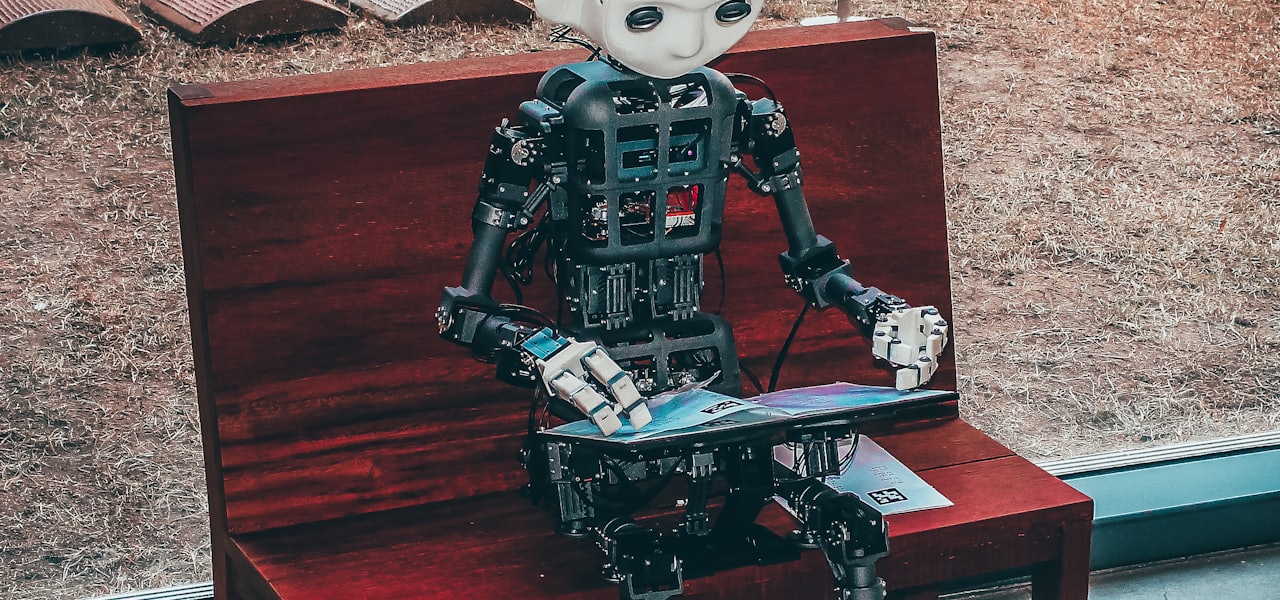
Embodied cognitive science is an interdisciplinary field of research, the aim of which is to explain the mechanisms underlying intelligent behavior. It comprises three main methodologies: the modeling of psychological and biological systems in a holistic manner that considers the mind and body as a single entity; the formation of a common set of general principles of intelligent behavior; and the experimental use of robotic agents in controlled environments. == Contributors == Embodied cognitive science borrows heavily from embodied philosophy and the related research fields of cognitive science, psychology, neuroscience and artificial intelligence. Contributors to the field include: From the perspective of neuroscience, Gerald Edelman of the Neurosciences Institute at La Jolla, Francisco Varela of CNRS in France, and J. A. Scott Kelso of Florida Atlantic University From the perspective of psychology, Lawrence Barsalou, Michael Turvey, Vittorio Guidano and Eleanor Rosch From the perspective of linguistics, Gilles Fauconnier, George Lakoff, Mark Johnson, Leonard Talmy and Mark Turner From the perspective of language acquisition, Eric Lenneberg and Philip Rubin at Haskins Laboratories From the perspective of anthropology, Edwin Hutchins, Bradd Shore, James Wertsch and Merlin Donald. From the perspective of autonomous agent design, early work is sometimes attributed to Rodney Brooks or Valentino Braitenberg From the perspective of artificial intelligence, Understanding Intelligence by Rolf Pfeifer and Christian Scheier or How the Body Shapes the Way We Think, by Rolf Pfeifer and Josh C. Bongard From the perspective of philosophy, Andy Clark, Dan Zahavi, Shaun Gallagher, and Evan Thompson In 1950, Alan Turing proposed that a machine may need a human-like body to think and speak: It can also be maintained that it is best to provide the machine with the best sense organs that money can buy, and then teach it to understand and speak English. That process could follow the normal teaching of a child. Things would be pointed out and named, etc. Again, I do not know what the right answer is, but I think both approaches should be tried. == Traditional cognitive theory == Embodied cognitive science is an alternative theory to cognition in which it minimizes appeals to computational theory of mind in favor of greater emphasis on how an organism's body determines how and what it thinks. Traditional cognitive theory is based mainly around symbol manipulation, in which certain inputs are fed into a processing unit that produces an output. These inputs follow certain rules of syntax, from which the processing unit finds semantic meaning. Thus, an appropriate output is produced. For example, a human's sensory organs are its input devices, and the stimuli obtained from the external environment are fed into the nervous system which serves as the processing unit. From here, the nervous system is able to read the sensory information because it follows a syntactic structure, thus an output is created. This output then creates bodily motions and brings forth behavior and cognition. Of particular note is that cognition is sealed away in the brain, meaning that mental cognition is cut off from the external world and is only possible by the input of sensory information. == The embodied cognitive approach == Embodied cognitive science differs from the traditionalist approach in that it denies the input-output system. This is chiefly due to the problems presented by the Homunculus argument, which concluded that semantic meaning could not be derived from symbols without some kind of inner interpretation. If some little man in a person's head interpreted incoming symbols, then who would interpret the little man's inputs? Because of the specter of an infinite regress, the traditionalist model began to seem less plausible. Thus, embodied cognitive science aims to avoid this problem by defining cognition in three ways. === Physical attributes of the body === The first aspect of embodied cognition examines the role of the physical body, particularly how its properties affect its ability to think. This part attempts to overcome the symbol manipulation component that is a feature of the traditionalist model. Depth perception, for instance, can be better explained under the embodied approach due to the sheer complexity of the action. Depth perception requires that the brain detect the disparate retinal images obtained by the distance of the two eyes. In addition, body and head cues complicate this further. When the head is turned in a given direction, objects in the foreground will appear to move against objects in the background. From this, it is said that some kind of visual processing is occurring without the need of any kind of symbol manipulation. This is because the objects appearing to move the foreground are simply appearing to move. This observation concludes then that depth can be perceived with no intermediate symbol manipulation necessary. A more poignant example exists through examining auditory perception. Generally speaking the greater the distance between the ears, the greater the possible auditory acuity. Also relevant is the amount of density in between the ears, for the strength of the frequency wave alters as it passes through a given medium. The brain's auditory system takes these factors into account as it process information, but again without any need for a symbolic manipulation system. This is because the distance between the ears for example does not need symbols to represent it. The distance itself creates the necessary opportunity for greater auditory acuity. The amount of density between the ears is similar, in that it is the actual amount itself that simply forms the opportunity for frequency alteration. Thus under consideration of the physical properties of the body, a symbolic system is unnecessary and an unhelpful metaphor. === The body's role in the cognitive process === The second aspect draws heavily from George Lakoff's and Mark Johnson's work on concepts. They argued that humans use metaphors whenever possible to better explain their external world. Humans also have a basic stock of concepts in which other concepts can be derived from. These basic concepts include spatial orientations such as up, down, front, and back. Humans can understand what these concepts mean because they can directly experience them from their own bodies. For example, because human movement revolves around standing erect and moving the body in an up-down motion, humans innately have these concepts of up and down. Lakoff and Johnson contend this is similar with other spatial orientations such as front and back too. As mentioned earlier, these basic stocks of spatial concepts are the basis in which other concepts are constructed. Happy and sad for instance are seen now as being up or down respectively. When someone says they are feeling down, what they are really saying is that they feel sad for example. Thus the point here is that true understanding of these concepts is contingent on whether one can have an understanding of the human body. So the argument goes that if one lacked a human body, they could not possibly know what up or down could mean, or how it could relate to emotional states. [I]magine a spherical being living outside of any gravitational field, with no knowledge or imagination of any other kind of experience. What could UP possibly mean to such a being? While this does not mean that such beings would be incapable of expressing emotions in other words, it does mean that they would express emotions differently from humans. Human concepts of happiness and sadness would be different because human would have different bodies. So then an organism's body directly affects how it can think, because it uses metaphors related to its body as the basis of concepts. === Interaction of local environment === A third component of the embodied approach looks at how agents use their immediate environment in cognitive processing. Meaning, the local environment is seen as an actual extension of the body's cognitive process. The example of a personal digital assistant (PDA) is used to better imagine this. Echoing functionalism (philosophy of mind), this point claims that mental states are individuated by their role in a much larger system. So under this premise, the information on a PDA is similar to the information stored in the brain. So then if one thinks information in the brain constitutes mental states, then it must follow that information in the PDA is a cognitive state too. Consider also the role of pen and paper in a complex multiplication problem. The pen and paper are so involved in the cognitive process of solving the problem that it seems ridiculous to say they are somehow different from the process, in very much the same way the PDA is used for information like the brain. Another example examines how humans control and manipulate their environment
(1+ε)-approximate nearest neighbor search
(1+ε)-approximate nearest neighbor search is a variant of the nearest neighbor search problem. A solution to the (1+ε)-approximate nearest neighbor search is a point or multiple points within distance (1+ε) R from a query point, where R is the distance between the query point and its true nearest neighbor. Reasons to approximate nearest neighbor search include the space and time costs of exact solutions in high-dimensional spaces (see curse of dimensionality) and that in some domains, finding an approximate nearest neighbor is an acceptable solution. Approaches for solving (1+ε)-approximate nearest neighbor search include k-d trees, locality-sensitive hashing and brute-force search.